
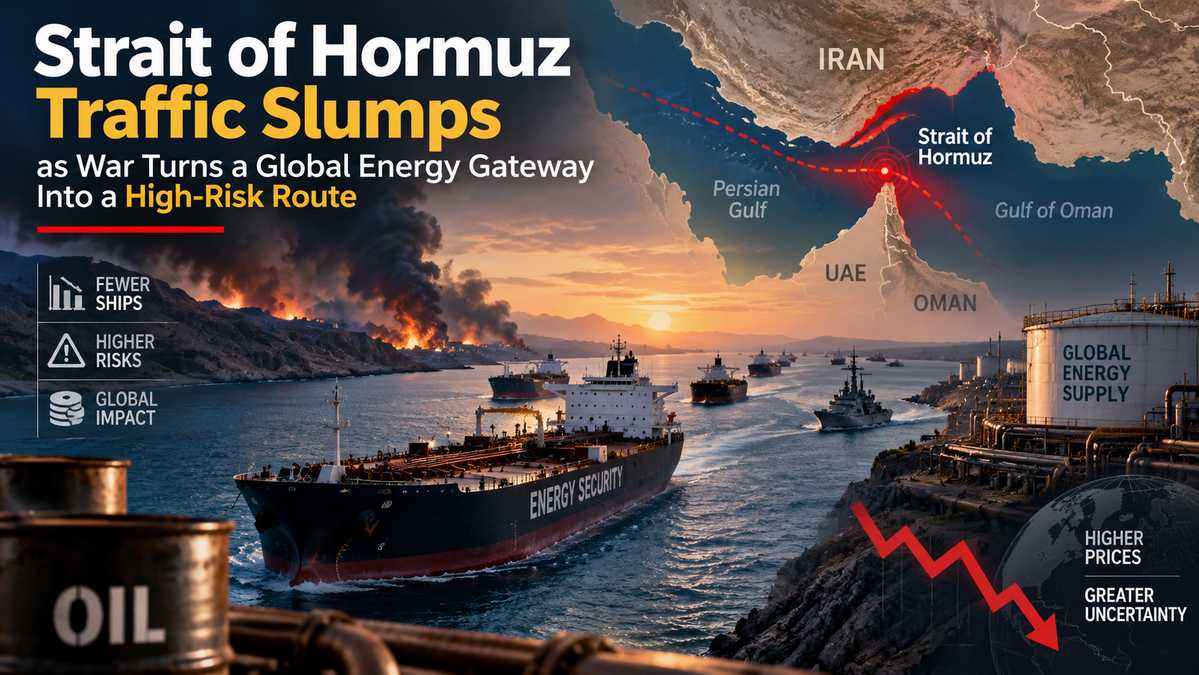
The Strait of Hormuz is becoming increasingly quiet at exactly the moment when the global economy needs it to remain open.
Shipping traffic through the narrow waterway has fallen sharply as fighting across the Middle East intensifies, with preliminary tracking data showing only a handful of commercial vessels making the passage. The decline is turning one of the world’s most important energy corridors into a growing source of uncertainty for oil, gas and shipping markets.
The latest numbers offer a striking picture.
On Tuesday, only four vessels were recorded crossing the Strait of Hormuz, down from 10 the previous day and far below the 10-day average of 18 crossings, according to preliminary ship-tracking data cited by Reuters.
But the most important part of the story is not simply the number of ships.
It is what that number says about confidence in one of the world’s most critical trade routes.
A Global Energy Highway Is Losing Traffic
Hormuz is not an ordinary shipping lane.
The waterway connects the Persian Gulf with the Gulf of Oman and the wider Indian Ocean, making it a crucial route for energy exports from Gulf producers.
About one-fifth of global oil and liquefied natural gas shipments normally pass through the waterway, meaning prolonged disruption can reach far beyond the countries directly involved in the conflict.
When vessels stop moving, the effects do not necessarily appear immediately at petrol stations or factories.
Instead, the disruption works its way through freight costs, insurance premiums, fuel markets, inventories and supply contracts.
In other words, Hormuz can be thought of as a valve in the global energy system.
If the valve narrows, pressure builds elsewhere.
The Traffic Collapse Has Been Building
The latest fall did not happen overnight.
Reuters shipping data has shown vessel crossings declining repeatedly in recent days.
On September 11, traffic had already fallen to seven commodity-vessel transits from 11 the previous day. Earlier in the week, six commodity vessels crossed on one day, compared with nine the day before.
The latest figure of four crossings therefore represents another stage in an already deteriorating pattern.
The change is especially significant when compared with the much higher traffic levels seen before the war.
The issue is no longer simply whether ships can pass through Hormuz.
It is whether owners, crews, insurers and cargo interests believe the risks are acceptable.
Why Are Shipowners Hesitating?
The answer lies in the widening security risks.
Reuters reported that an oil tanker exploded after what Iran described as a collision with naval mines, while the United States disputed that account and said the vessel had been struck by an Iranian missile. The conflicting explanations illustrate the uncertainty surrounding maritime incidents in the area.
Another vessel was also reported struck by an unknown projectile in the Strait of Hormuz, according to the United Kingdom Maritime Trade Operations agency.
For commercial shipping companies, uncertainty itself can become a major cost.
A vessel does not have to be destroyed for a route to become commercially unattractive.
If crews face higher security risks, insurers demand greater premiums or operators fear cargo losses and delays, companies can choose to wait, reroute or reduce voyages.
The Gulf Is Not the Only Route Under Pressure
The disruption is spreading beyond Hormuz.
The Bab el-Mandeb Strait, which connects the Red Sea with the Gulf of Aden, has also experienced reduced vessel traffic amid the broader regional conflict.
Reuters reported that traffic through Bab el-Mandeb fell from 28 transits to 21 in one day in the latest data cited by the news agency.
That creates a particularly difficult situation for global shipping.
Hormuz is critical to Gulf energy exports, while Bab el-Mandeb is a major gateway for vessels moving between the Red Sea and the Indian Ocean.
When both corridors face elevated security risks, the number of practical options available to shipping companies becomes smaller.
Saudi Arabia Is Facing Pressure on Multiple Fronts
The shipping disruption is occurring alongside attacks on Saudi Arabia and its energy infrastructure.
Houthi forces have launched missile and drone attacks on Saudi targets, while Saudi-led military action has continued in Yemen. Reuters reported that a Houthi attack on a Saudi military base was carried out in retaliation for Saudi airstrikes.
The conflict is therefore affecting both sides of the energy equation.
Ships are facing greater risks at sea while infrastructure on land is also coming under pressure.
That combination is particularly important for energy markets because oil supply depends on a chain of connected systems: production facilities, pipelines, ports, storage terminals and shipping routes.
Damage or disruption at any point can create problems elsewhere.
Oil Markets Are Watching Every Movement
The shipping slowdown has arrived at a time when oil markets are already sensitive to Middle East supply risks.
Brent crude recently traded above $100 a barrel, while supply concerns linked to Saudi infrastructure and Hormuz have continued to influence market sentiment.
Yet prices do not move in only one direction.
On September 16, Reuters reported that oil prices fell after a larger-than-expected increase in U.S. crude inventories, demonstrating how global supply concerns can compete with other market forces.
That is an important distinction.
A fall in shipping traffic does not automatically translate into an equivalent jump in oil prices every day.
Markets weigh several factors simultaneously, including inventories, production, demand, alternative supply routes and expectations about how long a disruption will last.
The LNG Risk Could Be Just as Important
Oil receives most of the headlines, but natural gas is another major concern.
Hormuz is an important route for liquefied natural gas exports from the Gulf.
A prolonged reduction in LNG shipping could affect countries that rely heavily on imported gas, particularly in Asia and other markets without large domestic supplies.
That can influence electricity generation, industrial production and heating costs.
The consequences could therefore extend well beyond the Middle East.
Diplomacy Is Now Part of the Shipping Story
The security situation is also affecting diplomatic efforts.
Reuters reported that planned talks between Gulf Arab states and Iran over the Strait have been delayed amid escalating tensions.
That matters because restoring maritime traffic is not simply a technical exercise.
Shipping companies need confidence that vessels will be protected and that the risks of crossing the waterway have fallen.
A diplomatic understanding could potentially improve that confidence.
Without one, even temporary security incidents can keep commercial operators cautious.
Countries Are Looking for Alternative Routes
The disruption is also pushing Gulf producers to rely more heavily on alternative infrastructure.
Saudi Arabia, for example, has been attempting to move more crude through other routes and has offered additional crude via ship-to-ship transfers off Oman’s Sohar port, according to Reuters.
Such measures can reduce some of the pressure created by a disrupted Hormuz route.
But alternatives cannot necessarily replace the waterway’s enormous capacity overnight.
That is why every additional day of unusually low traffic matters.
What Happens If the Decline Continues?
The biggest question is duration.
A short-lived traffic slowdown can be absorbed through inventories, alternative routes and delayed shipments.
A prolonged disruption is much more complicated.
Companies may have to redesign supply schedules. Importers could compete more aggressively for available cargoes. Shipping insurance could become more expensive. Energy-intensive industries could face higher operating costs.
Eventually, those additional expenses can reach consumers.
That does not mean a specific price increase is inevitable. The outcome depends on how long the disruption lasts and how effectively producers, governments and shipping companies adapt.
Hormuz Has Become a Confidence Test
The latest traffic numbers reveal something larger than a shipping slowdown.
They show how quickly geopolitical conflict can change the behavior of global commerce.
The Strait of Hormuz remains physically open to shipping, but the number of vessels using it has fallen dramatically.
That distinction is crucial.
A waterway does not have to be formally closed to become economically disruptive.
If enough companies decide that the risk is too high, traffic can fall even without an official blockade.
And that may be the most important development unfolding in Hormuz right now.
The World Is Watching the Ships
For years, the Strait of Hormuz was largely treated as an invisible component of the global energy system.
Millions of barrels of oil and large volumes of gas moved through it every day, while most consumers never had a reason to think about the narrow waterway between the Gulf and the Arabian Sea.
The latest conflict has changed that.
Four vessels crossing in a day, compared with a 10-day average of 18, is more than a shipping statistic.
It is a measure of how uncertainty is changing commercial behavior.
For energy markets, governments and businesses around the world, the question is no longer simply whether Hormuz is open.
The question is how long global shipping will remain willing to use it at anything close to normal levels—and what happens to energy supplies if that confidence does not return.