For much of its modern history, the United Kingdom has been one of the world’s most recognizable political unions.
Now, its future is once again becoming a constitutional question.
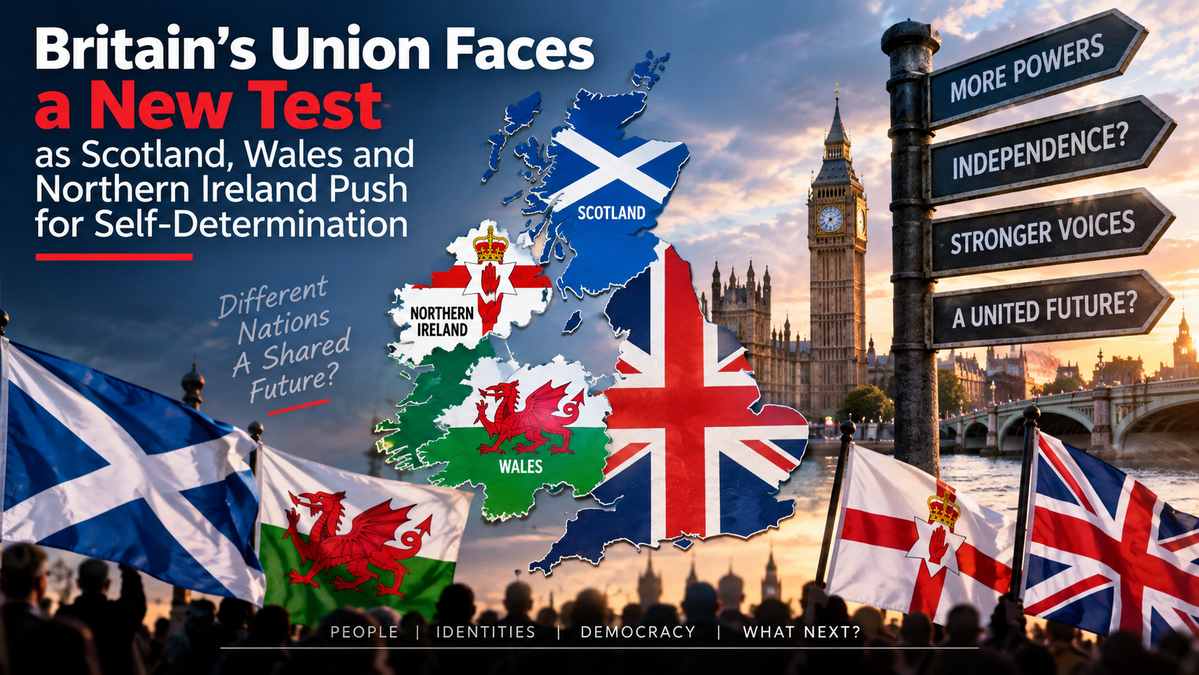
Scotland, Wales and Northern Ireland have moved closer together in an unusual political development, with leaders of their major pro-independence or pro-unification parties signing a joint agreement calling for the right of their nations to determine their own constitutional futures.
The meeting took place in Cardiff on September 14 and brought together Scottish National Party leader John Swinney, Plaid Cymru leader Rhun ap Iorwerth and Sinn Féin figures including Michelle O’Neill and Mary Lou McDonald. The agreement emphasized self-determination and argued that Westminster should not be able to block democratic decisions about the future of the three nations.
The development does not mean Britain is about to disappear.
But it does mark a significant change in the way the UK’s constitutional debate is being conducted.
A Union Facing Three Different Questions
It is tempting to describe Scotland, Wales and Northern Ireland as part of one growing independence movement.
The reality is more complicated.
Each has a different history, a different constitutional arrangement and a different possible route away from the UK.
Scotland is debating independence as a sovereign country.
Wales has a smaller but increasingly visible independence movement.
Northern Ireland faces a separate constitutional question: whether it should remain part of the United Kingdom or eventually become part of a united Ireland.
The three movements therefore overlap around the idea of self-determination, but their political objectives are not identical.
What Actually Happened in Cardiff?
The September 14 meeting has sometimes been portrayed as three governments agreeing to break up Britain.
That description goes further than the facts.
The politicians signed the memorandum as party leaders rather than as representatives formally committing their governments. The signatories included Swinney as SNP leader, ap Iorwerth as Plaid Cymru leader and O’Neill as a senior Sinn Féin figure.
The distinction matters.
The agreement is politically significant because the parties involved control or have major influence within their respective devolved political systems.
But it does not itself create three new countries or legally begin the dissolution of the United Kingdom.
Any actual constitutional change would require further political and legal steps.
Scotland: The Independence Question Returns
Scotland has already held an independence referendum.
In 2014, voters rejected independence, with 55.3% choosing to remain within the UK.
The issue did not disappear.
Brexit subsequently changed the political environment. Scotland voted to remain in the European Union in the 2016 Brexit referendum, while the UK as a whole voted to leave.
That difference has remained an important part of the Scottish independence argument.
The SNP continues to support independence, and Swinney has used the Cardiff meeting to reinforce the party’s demand for another referendum.
The UK government, however, has not agreed to simply authorize another vote.
That leaves Scotland facing a constitutional disagreement that has already lasted more than a decade.
Wales Is Asking a Different Question
Wales has historically had a weaker independence movement than Scotland.
But that does not mean the issue is marginal.
Plaid Cymru, the main Welsh nationalist party, has increasingly placed greater autonomy and independence within the political conversation.
At the Cardiff meeting, ap Iorwerth emphasized the principle of self-determination, although he did not announce a specific timetable for a Welsh independence referendum.
That is significant because Wales’ political debate is not currently at the same stage as Scotland’s.
Rather than an immediate referendum campaign, the discussion is increasingly about whether Wales should have greater control over its political and economic future.
Northern Ireland Has a Legally Different Path
Northern Ireland presents the most distinctive case.
Unlike Scotland and Wales, the constitutional future of Northern Ireland is directly addressed by the 1998 Good Friday Agreement.
The agreement provides a mechanism for a border poll on Irish unity if the relevant UK government secretary believes there is likely to be majority support for constitutional change.
That means a future vote on Irish unity has a recognized constitutional framework that does not exist in exactly the same form for Scottish or Welsh independence.
Sinn Féin has been pushing for a discussion about Irish reunification, including calls for a possible referendum in the coming years.
But a poll has not been called.
Why the Three Movements Have Joined Forces
The common ground is not necessarily a shared timetable.
It is the principle that people in each nation should have a decisive role in determining their constitutional future.
The Cardiff agreement stated that the nations have a right to self-determination and argued that no Westminster government should be able to block democratic choices about that future.
For the parties involved, cooperation also creates a larger political message.
Instead of Scotland, Wales and Northern Ireland making separate demands to London, they can present constitutional reform as a wider question about how power is distributed across the UK.
Westminster Still Holds Crucial Powers
Despite the political symbolism of the Cardiff agreement, Westminster remains central to the constitutional process.
The UK’s Parliament retains authority over major constitutional matters.
That means political declarations from devolved nations do not automatically create legal independence.
The gap between political demand and constitutional authority is therefore likely to become one of the central issues in the debate.
The three nations can demand referendums.
Westminster can disagree.
That creates the possibility of a prolonged political confrontation rather than an immediate breakup.
The Economic Question Will Be Harder Than the Political Slogan
Independence is not only about flags, national identity or constitutional principles.
It would involve practical questions about money, trade, borders, taxation, public spending and debt.
Scotland would have to determine its monetary and fiscal arrangements.
Wales would face questions about the economic relationship it currently has with the wider UK.
Northern Ireland would face an entirely different set of issues if it ever moved toward Irish unity, including the relationship between Northern Ireland, the Republic of Ireland and the wider UK.
None of these questions is resolved by the Cardiff agreement.
They would become central only if any of the constitutional campaigns moved toward an actual referendum and negotiations.
Defense Would Become Another Major Issue
The UK’s military structure adds another layer of complexity.
Scotland is home to Britain’s nuclear submarine base at Faslane.
If Scotland became independent, the future of the UK’s nuclear deterrent and its military facilities would become a major negotiating issue.
There would also be questions about military personnel, bases, procurement, intelligence arrangements and maritime security.
These are not minor administrative details.
They would affect the UK’s role as a major military power and Scotland’s future relationship with its neighbors.
Brexit Changed the Constitutional Conversation
The independence debate also cannot be separated from Brexit.
The 2016 referendum exposed significant differences between the UK’s constituent nations.
Scotland voted to remain in the European Union, while the UK as a whole voted to leave.
For Scottish nationalists, Brexit became an argument that decisions made at Westminster can take Scotland in a direction that many Scottish voters did not choose.
The same broader issue—who gets to make major political decisions—now appears in the language of self-determination used by the three parties in Cardiff.
Trump Has Added Another Complication
The debate has also attracted international attention.
US President Donald Trump recently expressed support for Irish reunification, saying he would like to see Ireland become united.
The comments prompted a response from the UK government, which reiterated that its position on Irish unity had not changed. The British government has said a border poll would depend on the legal conditions established under the Good Friday Agreement rather than outside political endorsements.
That means the Irish question is now being discussed not only in Belfast, Dublin and London, but also in Washington.
A Breakup Is Possible in Theory, But Not Inevitable
The language surrounding the current developments can make it sound as though the United Kingdom is already on the verge of dissolution.
The evidence does not establish that.
The three movements face different levels of public support, different political strategies and different legal pathways.
Recent reporting describes Scottish support for independence as closely divided, while support for Welsh independence remains considerably more limited. Northern Ireland’s situation is also shaped by its distinctive constitutional framework.
Political momentum can change, but a coordinated declaration is not the same thing as a successful independence process.
What Would a Different UK Look Like?
If Scotland became independent, Wales became independent and Northern Ireland eventually joined the Republic of Ireland, the political map of these islands would be dramatically different.
England would remain the largest component of what is now the UK, but the United Kingdom itself would no longer exist in its current form.
There would have to be negotiations over citizenship, borders, trade, government assets, public debt, defense arrangements, international treaties and countless other practical matters.
Even the question of what happens to the UK’s international institutions and diplomatic commitments would require careful negotiation.
The Historical Irony Behind the Headlines
The comparison with Britain’s former empire, including India, gives the story an especially striking historical dimension.
The British Empire once governed vast territories across the world.
Today, political debates inside the United Kingdom itself are increasingly centered on national identity, autonomy and the right of constituent nations to decide their own future.
But history should not be used to imply that the current movements are simply reversing Britain’s colonial past.
The modern constitutional debate is driven by contemporary questions about democratic authority, national identity, economic policy and the distribution of power.
The Real Battle Is Over Who Gets to Decide
That may ultimately be the most important question emerging from Cardiff.
The immediate issue is not whether the UK has already broken apart.
It has not.
The immediate issue is who should have the authority to decide whether the union continues in its current form.
Scotland wants another opportunity to put independence to voters.
Plaid Cymru is advancing the case for Welsh self-determination without yet setting the same referendum timetable.
Sinn Féin is seeking progress toward a debate on Irish reunification.
Westminster continues to hold decisive constitutional powers and has not accepted the idea that these demands automatically lead to referendums.
That creates a political contest between two principles: the authority of the existing UK constitutional system and the demands of nationalist parties for greater control over their own futures.
Britain’s Next Constitutional Chapter
The United Kingdom has survived major political changes before.
It has also changed its own shape over time.
The creation of the UK, the incorporation of Ireland, the independence of most of Ireland in 1922 and the development of devolved governments in Scotland, Wales and Northern Ireland all transformed the political map.
The latest development is different because the pressure is now coming from several directions at once.
Scotland, Wales and Northern Ireland are not following identical paths.
They do, however, share an increasingly prominent demand: that decisions about their constitutional futures should ultimately involve the people who live there.
Whether that demand produces referendums, greater devolution or eventually new independent states remains unresolved.
For now, the more accurate story is not that Britain is breaking up.
It is that Britain’s old constitutional settlement is facing one of its most coordinated tests in decades—and the question of who gets to decide the future of the union is becoming harder for Westminster to avoid.