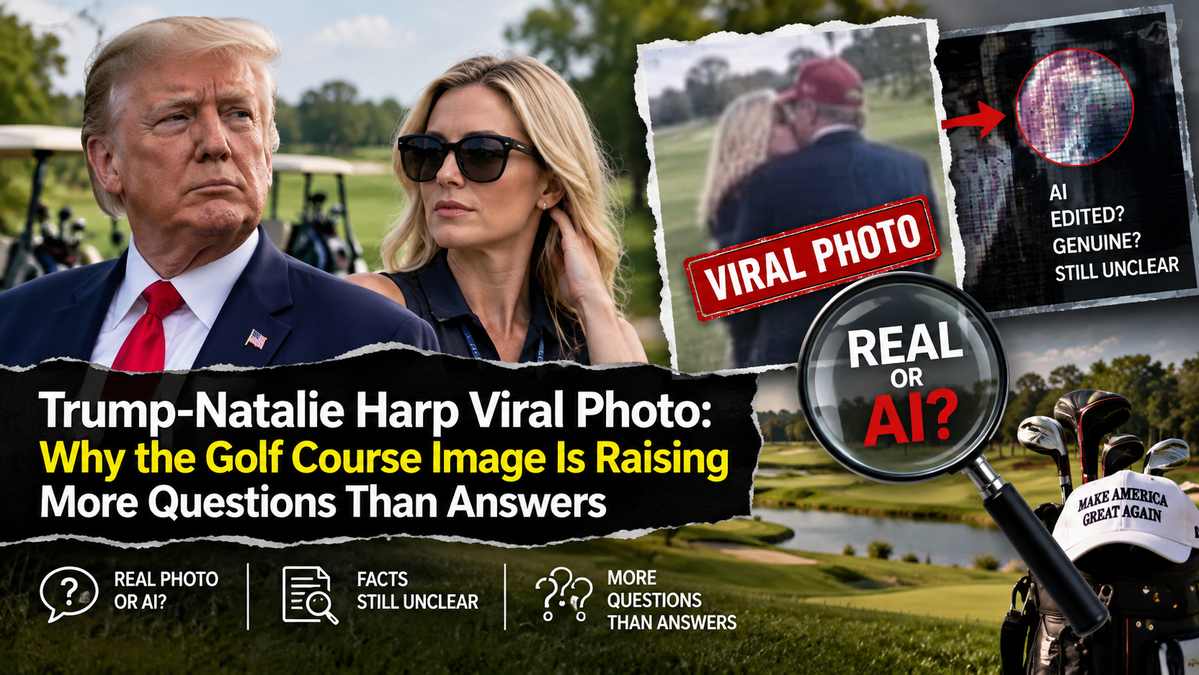
A photograph claiming to show US President Donald Trump kissing his executive assistant Natalie Harp has spread rapidly online, triggering speculation about the relationship between the two.
But the biggest story may not be what the photograph appears to show.
It is what the image cannot prove.
The picture has no verified photographer, confirmed date, established location or credible photographic source attached to it. Different versions of the image are circulating, and fact-checkers have found strong evidence that at least the higher-quality version was created or manipulated with artificial intelligence.
That leaves a crucial question: Is a viral image automatically evidence of an event simply because it looks convincing?
In this case, the answer is far from clear.
How the Trump-Harp Photo Went Viral
The image shows a man resembling Trump standing close to a blonde woman who is presented online as Harp. The pair appear to be on a golf course, with a golf cart and golf equipment visible in the background.
The apparent kiss is what immediately attracted attention.
Social-media posts quickly began presenting the picture as evidence of an alleged romantic relationship between Trump and Harp.
However, there is no credible evidence establishing that the photograph depicts such an encounter. NDTV reported that the image remained unauthenticated and appeared likely to have been digitally altered or generated using AI.
That distinction is important because the photograph itself has not established either the identity of the woman or the authenticity of the scene.
There Are Two Versions of the Image
One of the most interesting parts of the controversy is that the internet is not dealing with just one version of the photograph.
A blurry, low-resolution version has circulated widely.
A sharper version has also appeared online, and that version contains conspicuous visual irregularities.
Fact-checkers identified what appears to be an extra finger on the woman’s hand in the clearer image. Lead Stories reported that an AI-detection tool assessed the sharper version as highly likely to have been AI-generated, while an OpenAI verification tool detected a SynthID watermark associated with OpenAI tools.
Those findings provide strong evidence against treating the high-resolution version as an authentic photograph.
But there is an important complication.
The Blurry Version Is a Different Question
The existence of an AI-generated high-resolution version does not automatically prove that the blurry image was also generated by AI.
This is where the story becomes more complicated than a simple “real or fake” headline.
Lead Stories tested the blurry version with several detection tools but did not receive results identifying it as AI-generated. The organization also found that the earliest copies it could trace were posted on social media without a photographer’s credit or information about where the picture came from.
Snopes reached a similar conclusion: it found strong AI indicators in the higher-resolution version but said the authenticity of the low-resolution version remained unresolved.
In other words, “the clear version is AI-generated” and “the blurry version is definitely real” are not equivalent statements.
No Verified Source Behind the Photograph
Authentic news photographs normally leave some kind of trail.
There may be a photographer, a wire service, an event record, another photograph from the same moment or multiple independent images showing the same scene.
That trail is missing here.
Snopes reported that reverse-image searches did not locate the photograph in credible news organizations or major photographic repositories. It also found no photographer, date or location associated with the circulating versions.
That does not mathematically prove that an image is fake.
It does, however, make the photograph impossible to treat as established evidence.
Even the Woman’s Identity Is Not Certain
There is another problem hiding in plain sight.
The woman’s face is not clearly visible.
That means identifying her as Natalie Harp is itself an interpretation rather than something conclusively demonstrated by the photograph.
Harp is a close Trump aide and has accompanied him on golf outings and official travel, making the claim appear superficially plausible to people already familiar with photographs of the two together. NDTV reported that she has been seen with Trump during golf outings and his recent trip to Ireland.
But being photographed together elsewhere does not authenticate a different photograph.
That is one of the easiest traps in the age of viral misinformation: a real relationship between two people can make a fabricated image involving those same people appear more believable.
Trump and Harp Really Have Been Seen Together
This is an important part of the story because the viral image did not emerge from nowhere.
Harp has a documented role as a member of Trump’s inner circle and has traveled with him. Her frequent proximity to the president has already attracted media attention.
During Trump’s recent Ireland trip, for example, Harp accompanied him while he visited his Doonbeg golf resort.
That genuine background provides context for the viral photograph.
But context should not be confused with confirmation.
A person being present at a real golf outing does not establish that a particular viral image from a golf course is genuine.
The White House Has Rejected the Image
The White House has also weighed in.
According to Snopes, a White House official described the circulating image as “clearly a fake photo.” The White House did not provide the requested legitimate photographs of Trump and Harp golfing that Snopes sought for comparison.
That statement is the administration’s characterization of the photograph, rather than an independent forensic finding.
The independent evidence is more nuanced: the sharper image contains strong indicators of AI generation, while the origin and authenticity of the blurry version remain unresolved.
Why AI Changes the Rules of Viral Photos
For decades, people were taught to question obviously manipulated pictures.
Now the problem is different.
AI-generated images can look realistic enough that the human eye may not immediately notice anything wrong.
An extra finger, distorted golf equipment or an unusual background might be dismissed as a camera artifact. A low-resolution copy can make those imperfections even harder to detect.
That creates a dangerous feedback loop.
Someone creates a convincing image.
Another account reposts it.
A third account adds a dramatic caption.
Thousands of people see the caption and assume the image itself is proof.
Soon, the original question—“Where did this photograph come from?”—gets lost.
A Realistic Image Is Not the Same as a Verified Image
That may be the most important lesson from the Trump-Harp controversy.
The photograph looks plausible because Trump and Harp really are known to spend time in the same places.
The setting looks plausible because Trump is known for golfing.
The people appear plausible because Harp has been photographed accompanying him.
But plausibility is not authentication.
A genuine-looking image still needs provenance.
That means establishing where it originated, when it was taken, who took it and whether independent evidence supports what it appears to show.
Social Media Can Reverse the Normal Burden of Proof
Normally, evidence is supposed to establish a claim.
With viral images, the process often works backward.
A photograph appears first.
People then build a story around it.
The story becomes widely repeated.
Finally, the repetition itself starts being treated as evidence.
The Trump-Harp photograph demonstrates why that process is risky.
The viral nature of the image does not make it more authentic. In fact, widespread sharing can make verification more difficult because altered versions, cropped versions and screenshots quickly become mixed together.
What About Claims of a Romantic Relationship?
The photograph has fueled online speculation about Trump and Harp.
But the image cannot establish such a relationship.
There is currently no verified evidence from this photograph demonstrating that Trump and Harp were romantically involved.
That is an important distinction from simply reporting that the two have a close professional relationship.
Harp’s proximity to Trump is documented. The alleged kiss shown in the viral image is not.
Turning an unverified photograph into a claim about someone’s private life would therefore go well beyond what the available evidence supports.
The Bigger Story Is About Trusting Images
The controversy arrives at a time when determining whether an image is authentic is becoming increasingly difficult.
Even sophisticated detection tools have limitations.
Lead Stories found that its tools did not identify AI signals in the blurry photograph, while the clearer version produced much stronger evidence of artificial generation.
That difference is a reminder that AI detection is not a magic button.
The strongest verification usually comes from combining technical analysis with traditional reporting: source information, timestamps, photographic archives, eyewitness accounts, official records and independent images.
What We Actually Know
At this stage, several facts can be separated from the speculation.
A viral image purporting to show Trump kissing Natalie Harp is circulating online.
Harp is a real Trump aide who has accompanied him during golf outings and travel.
The clearer version of the viral image contains significant signs of AI generation or manipulation.
There is no verified photographer or credible original source establishing the image’s provenance.
The identity of the woman in the blurry version cannot be conclusively established from the image alone.
And the photograph should not be treated as evidence of a romantic encounter.
The Lesson Beyond Trump and Harp
The most revealing part of this episode may have nothing to do with Trump or Harp.
It is a warning about the next generation of misinformation.
A decade ago, people worried about photoshopped pictures.
Today, the more difficult problem is an image that looks authentic, spreads faster than it can be checked and arrives without a reliable source.
The question consumers need to ask is no longer simply, “Does this look real?”
It is:
“Who took it, when was it taken, where did it first appear, and what independent evidence confirms it?”
Until those questions have convincing answers, a viral photograph remains a claim—not proof.
And in the case of the alleged Trump-Natalie Harp golf-course kiss, the evidence currently supports caution rather than certainty.