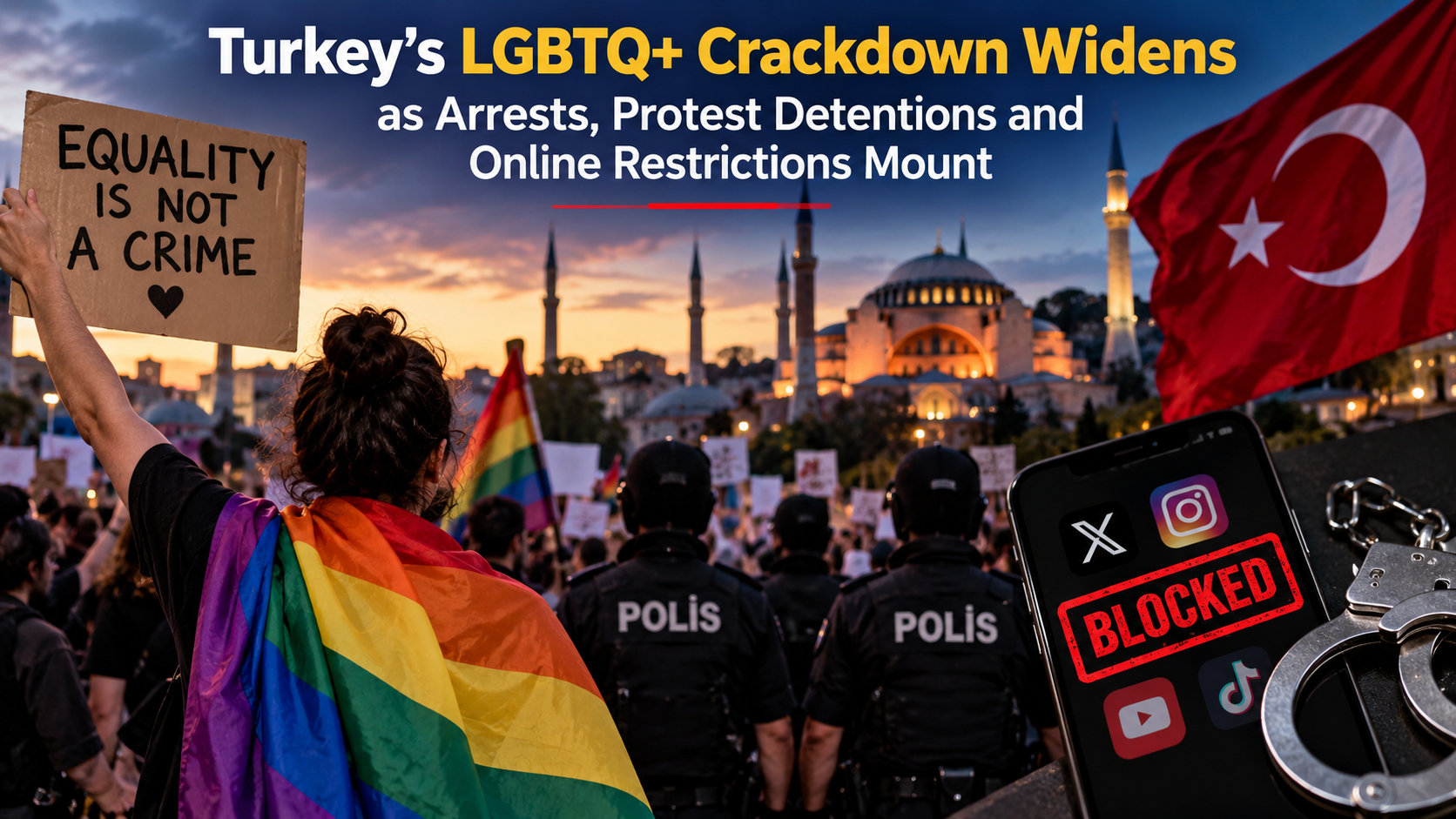
Turkey’s latest crackdown on LGBTQ+ groups has moved beyond raids and arrests, spilling into the streets as police detain protesters and authorities restrict access to LGBTQ+ organizations and some independent media accounts.
At least 31 people were placed in custody pending trial on Tuesday, while police detained at least 126 protesters in Ankara and Istanbul, according to lawyers cited by Reuters. The developments came after a series of raids targeting LGBTQ+ associations across the country.
The numbers tell only part of the story.
The larger development is the widening confrontation between Turkish authorities and LGBTQ+ organizations, activists and their supporters over what the government describes as protecting children and family values—and what rights groups describe as discriminatory restrictions on civil society.
A Crackdown That Is Spreading Across Turkey
The latest arrests are part of an investigation covering 15 provinces, according to Turkish Justice Minister Akin Gurlek.
Authorities say the investigation involves 162 suspects, nine associations and 13 businesses, with prosecutors in Istanbul, Ankara, Izmir, Aydin and Mersin coordinating the operation.
The campaign has been given the name “My Family is Safe.”
The government says the operation is intended to protect children, families and public order. Prosecutors have cited alleged offenses including prostitution and obscenity in the investigations.
But the scope of the operation has prompted criticism from rights organizations, opposition figures and European human-rights officials.
31 People Held Pending Trial
The latest legal action included five transgender women in Ankara and 26 people in the southern province of Mersin, lawyers said.
A separate court proceeding in Izmir had already resulted in people being ordered into pretrial detention following the earlier raids. Reuters reported that 18 people were initially detained there, with lawyers saying 16 were ordered jailed pending trial.
The wording matters.
Being jailed pending trial does not mean those individuals have been convicted of a crime. It means a court has ordered them held while the legal process continues.
That distinction is particularly important in a case where allegations, investigations and political criticism are developing simultaneously.
Protests Turn the Crackdown Into a Public Confrontation
The arrests have triggered demonstrations in several cities.
In Istanbul, protesters gathered outside the Caglayan courthouse to demand the release of people detained during the LGBTQ+ raids. Police prevented the group from delivering a planned press statement and detained demonstrators.
In Ankara, police also dispersed people attempting to gather in support of LGBTQ+ rights.
The protests have therefore created a second front in the dispute.
The initial confrontation centered on police raids and criminal investigations.
It is now also about whether activists can publicly demonstrate against those measures.
Why the Numbers Keep Changing
Early reports put the number detained during the protests at more than 150, while later information cited by Reuters said at least 126 protesters had been detained in Ankara and Istanbul.
That difference reflects the fact that detentions were occurring across multiple locations and that figures can change as people are released, transferred or formally processed.
The broader picture remains clear: large numbers of people have been detained in connection with both the crackdown and the demonstrations against it.
The Government’s Argument: Children and Family Values
Turkish authorities have presented the operation primarily through the language of child protection, family and public order.
Justice Minister Akin Gurlek has said the campaign is aimed at preventing criminal activity involving children and young people and protecting what the government describes as the institution of the family.
Prosecutors have also cited allegations involving prostitution and obscenity.
The government says the investigations are therefore connected to alleged criminal conduct rather than simply to people’s sexual orientation.
That is the official justification for the operation.
Rights Groups See a Much Broader Pattern
Human-rights organizations have rejected the government’s characterization of the campaign.
Amnesty International said the crackdown represented an escalation against LGBTI organizations and activists, reporting that more than 60 people had been arrested across 15 provinces since Sunday and that criminal investigations involved more than 160 people.
The organization also criticized restrictions placed on social-media accounts and websites connected with LGBTQ+ groups and activists.
Other rights organizations have similarly argued that the operation goes beyond legitimate criminal investigations and contributes to discrimination and pressure on civil society.
Those are assessments by rights groups, rather than findings of a court.
Europe Raises Human-Rights Concerns
The criticism has also reached European institutions.
Michael O’Flaherty, the Council of Europe’s Commissioner for Human Rights, said he was concerned about the arrests, raids and online restrictions targeting LGBTQ+ civil-society groups and human-rights defenders.
He argued that references to family values or protecting children, by themselves, should not be used as justification for restricting human rights.
He called for the release of people detained for human-rights or civil-society work.
His intervention adds an international dimension to a dispute that began with domestic police investigations.
The Online Front Is Growing Too
The crackdown has not been limited to physical arrests.
Turkish authorities have also blocked access to websites and social-media accounts belonging to various LGBTQ+ organizations, individuals and some independent media outlets, according to Reuters.
Among the accounts affected was the X account of Amnesty International’s Turkey branch.
Amnesty said X informed its Turkish organization that the account had been blocked following a decision communicated by Turkey’s Cyber Security Presidency. The organization said it had sought the legal basis for the decision.
This adds another layer to the dispute.
For organizations operating in the digital age, restricting online access can affect their ability to communicate with supporters, publish information and organize public activity.
Why This Is Bigger Than a Series of Arrests
The significance of the latest events lies partly in their scale.
Authorities are investigating people across 15 provinces.
Associations and businesses have been targeted.
Websites and social-media accounts have faced restrictions.
People protesting the crackdown have also been detained.
Taken together, those developments show that the dispute is no longer confined to individual criminal cases.
It has become a broader contest over the space available to LGBTQ+ organizations and activists to operate publicly.
Turkey’s LGBTQ+ Debate Has Been Intensifying
The latest operation comes after years of growing restrictions on LGBTQ+ events and public expression in Turkey.
Istanbul’s Pride events have faced bans and police intervention, while the government under President Recep Tayyip Erdogan has increasingly emphasized traditional family structures in its political messaging.
The current campaign is also connected to Erdogan’s broader “Decade of Family and Population” initiative, which focuses on demographic concerns, families and children.
That broader political context helps explain why the latest arrests have attracted international attention.
The Legal Process Will Now Matter
The next stage of the story will take place through Turkey’s courts.
Investigators will have to determine which allegations can be supported by evidence and which suspects will remain in custody, face other judicial measures or be released.
For the people already placed in pretrial detention, the distinction between accusation and conviction is particularly important.
A criminal investigation can involve serious allegations without those allegations ultimately being proven in court.
Protesters Face Their Own Legal Questions
Those detained during demonstrations also face uncertainty.
The authorities’ response to protests will be closely watched because it raises questions separate from the original investigations.
A government can investigate alleged criminal conduct involving particular individuals while protesters can simultaneously challenge the government’s policies.
Whether those protests are permitted, restricted or dispersed becomes part of the wider debate about freedom of expression and assembly.
A Battle Over the Meaning of “Family Values”
At the heart of the dispute is a fundamental disagreement over what the government’s language means in practice.
Turkish authorities say protecting children and families justifies the measures being taken.
Rights organizations argue that those concepts should not be used to restrict LGBTQ+ people or civil society organizations.
European human-rights officials have also questioned whether such broad references provide sufficient justification for restrictions on fundamental rights.
The competing arguments are likely to remain central as the legal cases develop.
What Happens Next?
The immediate focus will be on the people already detained, the evidence gathered during the raids and the decisions of Turkish courts.
At the same time, activists and rights organizations are likely to continue challenging the restrictions through public protests and international advocacy.
The government’s investigation could also expand because officials have said it covers 162 suspects and organizations across numerous provinces.
That means the current arrests may represent only one stage of a much larger legal and political confrontation.
Turkey’s New LGBTQ+ Flashpoint
What began with coordinated police raids has quickly developed into a wider struggle involving courts, streets, social-media platforms and civil-society organizations.
At least 31 people have been placed in pretrial custody in the latest round, while more than 100 protesters have been detained during demonstrations against the crackdown.
The government says its campaign is about protecting children, families and public order.
Rights groups and European officials say the measures threaten LGBTQ+ rights and civil society.
Those competing claims will now be tested through legal proceedings and continued public scrutiny.
For Turkey, the issue is no longer simply about a series of police raids.
It is becoming a broader question about where the boundaries lie between criminal enforcement, public protest, online expression and the rights of LGBTQ+ organizations to operate in society.