For several days, New Delhi was the stage for conversations involving presidents, prime ministers and senior leaders from some of the world’s most influential countries.
But as Abu Dhabi Crown Prince Sheikh Khaled bin Mohamed bin Zayed Al Nahyan prepared to leave India, it was not a major diplomatic announcement that captured widespread attention.
It was a brief handshake.
A video showing the Crown Prince turning back before his departure from New Delhi to personally greet the Indian driver who had accompanied him during his visit has been widely shared online. The understated moment has drawn attention because it came at the end of a visit otherwise dominated by formal meetings and high-level diplomacy.
The Moment That Happened Away From the Diplomatic Spotlight
The video shows Sheikh Khaled preparing to leave after his engagements in the Indian capital.
He appears to begin walking toward his aircraft after greeting officials and those present to see him off. Then he turns back, walks toward the vehicle and approaches the driver.
The Crown Prince shakes the driver’s hand and briefly speaks with him before continuing his departure. Reports also describe him making a brief gesture toward the driver during the interaction.
There was no major speech or ceremony attached to the exchange.
That is precisely what made the footage stand out.
In an environment where diplomatic visits are usually measured through meetings, agreements and official statements, the short personal interaction offered something very different.
From BRICS Meetings to a Personal Farewell
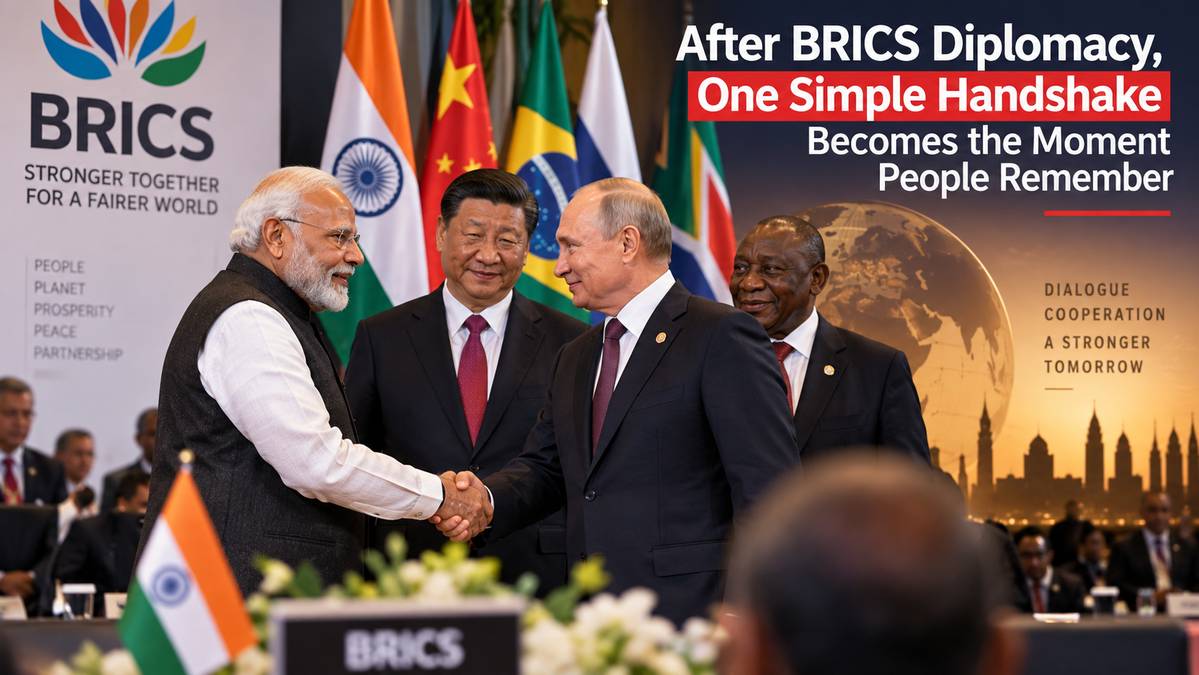
Sheikh Khaled was in New Delhi representing UAE President Sheikh Mohamed bin Zayed Al Nahyan at the 18th BRICS Summit.
During the visit, he took part in high-level engagements, including discussions with Indian Prime Minister Narendra Modi. The summit itself brought together leaders from major emerging economies and focused on issues extending well beyond bilateral relations.
The UAE’s presence at the summit also carried wider diplomatic significance.
The BRICS meeting took place against the backdrop of serious tensions in the Middle East, making contacts between regional leaders particularly important.
Reuters reported that Sheikh Khaled also met Iranian President Masoud Pezeshkian during the summit, while Iran and the UAE joined other BRICS members in endorsing a statement calling for restraint and emphasizing civilian protection, sovereignty and maritime stability.
Yet after all those high-level encounters, a few seconds at an airport became one of the most widely shared moments associated with his departure.
Why the Gesture Resonated
The appeal of the video is fairly straightforward.
A Crown Prince is normally seen in formal settings, surrounded by officials, security personnel and diplomats.
Here, the focus was on an ordinary professional interaction.
The driver was not delivering a speech or participating in a diplomatic meeting. He was simply the person who had driven the visiting leader during his time in Delhi.
By turning back to acknowledge him personally, Sheikh Khaled created a small moment of recognition at the end of an otherwise highly formal trip.
Indian media outlets and social-media users widely praised the gesture, describing it as a sign of courtesy and humility.
It is worth keeping the distinction clear, however: the video shows a handshake and brief interaction. Descriptions of what the gesture “means” beyond that are interpretations by viewers and commentators.
The Human Side of a Diplomatic Visit
Diplomatic visits are usually reported through an official lens.
There are meetings with heads of government.
There are discussions about trade, energy, defense, investment and technology.
There are carefully prepared photographs and formal statements.
But international visits also depend on hundreds of people whose work rarely appears in the headlines—drivers, security personnel, hotel staff, protocol officials, translators and other support teams.
The Delhi farewell offered a glimpse of that less visible side of diplomacy.
The person standing behind the wheel was not part of the headline-making negotiations, but he was still part of the machinery that allowed the visit to happen smoothly.
The Crown Prince’s decision to walk back and greet him made that usually invisible role visible for a moment.
India-UAE Relations Were Bigger Than the Viral Video
The handshake should not overshadow the broader purpose of Sheikh Khaled’s visit.
India and the UAE have been expanding cooperation across areas including trade, investment, energy, infrastructure and connectivity.
During the BRICS summit, discussions between Indian and UAE leaders also included the India-Middle East-Europe Economic Corridor and energy infrastructure, according to recent reporting.
Those issues have much greater long-term policy significance than a viral airport video.
The video, however, provides a human entry point into a much larger story about increasingly close engagement between New Delhi and Abu Dhabi.
A Different Kind of Diplomatic Image
There is something unusual about the way this moment spread.
Formal diplomatic photographs often disappear from public attention quickly because they look similar from one summit to another.
A spontaneous-looking interaction is different.
People can immediately understand what is happening without needing background information.
One person turns around.
Another person is waiting near a car.
They shake hands.
Then the visiting leader leaves.
It is a simple scene, but its simplicity is precisely what makes it easy to connect with.
Why Small Moments Can Outlast Big Speeches
Politics and diplomacy are filled with complicated subjects.
Leaders discuss wars, trade barriers, energy security, investment and strategic partnerships.
Those discussions can have consequences for millions of people, but they are difficult to capture in a few seconds of video.
A gesture of courtesy is different.
It requires no technical explanation.
That may help explain why the Crown Prince’s farewell quickly attracted attention online.
The moment transformed a highly formal diplomatic trip into something more personal and relatable.
The Broader Message of Recognition
The episode also highlights something that often gets lost in discussions about international diplomacy: relationships are not built only through agreements between governments.
They are also sustained through countless individual interactions.
A visiting delegation depends on local staff.
Officials depend on drivers and security teams.
Large summits depend on people working behind the scenes long before cameras arrive.
Recognizing those contributions does not change foreign policy, but it can change how people perceive the human side of public life.
The BRICS Summit Had a Much Bigger Story
The farewell came after a summit that carried considerable geopolitical weight.
BRICS members discussed global economic cooperation while the Middle East remained under severe strain.
Reuters reported that the summit also provided an opportunity for engagement between the UAE and Iran, including the meeting between Sheikh Khaled and President Pezeshkian. The joint BRICS statement called for restraint and the protection of civilians and global trade.
Against that backdrop, the Crown Prince’s handshake was almost deliberately ordinary.
And that contrast is what made it memorable.
The summit dealt with issues involving nations and geopolitical interests.
The farewell involved one leader and one driver.
What the Video Does—and Does Not—Show
The viral footage should also be viewed for what it actually establishes.
It shows Sheikh Khaled returning to the vehicle, greeting the driver and shaking his hand before departing.
Reports say he briefly spoke with the driver, and footage shows the interaction lasting only a short time.
Claims about his personal motivations or the exact words exchanged should not be treated as established unless independently documented.
That distinction matters, especially when short social-media videos quickly attract commentary and speculation.
A Farewell That Became the Story
Sheikh Khaled’s visit to India involved diplomacy at the highest level.
There were meetings with political leaders, discussions about bilateral cooperation and participation in a major international summit.
Yet the image that travelled furthest was much smaller.
A Crown Prince was about to leave New Delhi, then turned around.
He walked back to the person who had driven him.
He offered a handshake and a few words.
Then he left.
Perhaps that is why the video resonated so strongly. In a world where official visits are often defined by podiums and protocol, the moment offered something uncomplicated: a public figure acknowledging someone whose work normally happens outside the spotlight.
The handshake did not rewrite the substance of India-UAE relations or the diplomatic outcomes of the BRICS summit.
But it gave the visit a human ending—and sometimes, it is the smallest moments that remain in people’s minds the longest.