
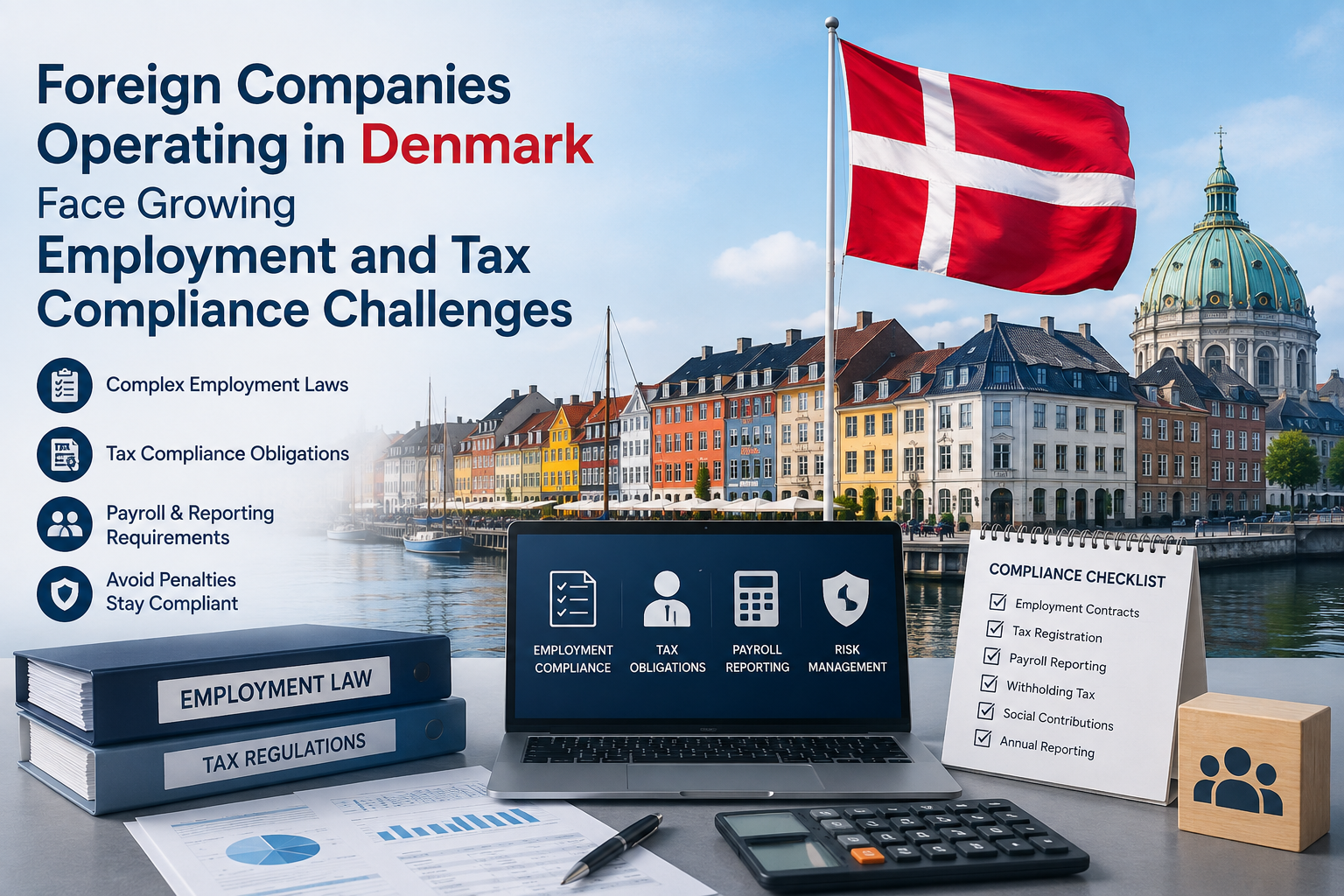
Denmark remains an attractive market for international companies, but doing business in the country can create legal and tax obligations sooner than some foreign businesses expect.
A company does not necessarily need to establish a large Danish subsidiary before Danish rules become relevant. Sending employees to Denmark, maintaining a fixed place of business, working on long-term projects or supplying employees to a Danish company can all raise important questions.
For foreign businesses, three areas deserve particular attention: permanent establishment, employee taxation and payroll withholding obligations.
These issues are especially relevant to companies following international business developments through Lead Roedl, as cross-border operations can bring corporate, employment and tax rules together in a single project.
Operating in Denmark Can Create Tax Obligations
A foreign company entering Denmark may initially see its activities as temporary.
Perhaps a German company sends employees to work on a Danish project. A Swedish business assigns staff to a Danish customer. An international company establishes a small office while testing the local market.
The tax consequences depend on the circumstances.
According to the Danish Tax Agency, foreign businesses operating in Denmark need to consider matters including:
- Whether they have a permanent establishment in Denmark
- Whether employees become taxable in Denmark
- Whether Danish payroll taxes must be withheld
- Whether the business must register in Denmark
- Whether RUT registration is required
- Whether the international hiring-out of labour rules apply
Ignoring these questions can result in unexpected tax and administrative obligations.
Permanent Establishment Is a Key Question
One of the most important concepts for a foreign company is permanent establishment, often shortened to PE.
The Danish Tax Agency states that if a foreign business establishes a permanent establishment in Denmark, it must pay Danish tax on profits generated through its Danish activities.
It must also withhold tax on salary earned by employees working in Denmark where the relevant withholding requirements apply.
A permanent establishment will generally require business activities to be carried out from a fixed place of business and with a sufficient degree of permanence.
A fixed place could include an office, branch, factory, workshop or another location from which the company’s business is conducted.
The practical challenge is that a company may create a taxable presence without thinking of itself as having established a conventional Danish office.
Construction Projects Have Special Considerations
Construction and development projects illustrate why businesses need to look beyond simple assumptions.
The Danish Tax Agency explains that special rules apply to these activities, and the period required to create a permanent establishment can depend on the applicable agreement between Denmark and the company’s home country.
For example, the relevant period may be six months under one applicable treaty and 12 months under another.
The circumstances therefore matter.
A foreign contractor working on a Danish project should not assume that its tax treatment will be identical to that of another international contractor simply because both businesses are carrying out similar work.
The applicable tax treaty, duration of the project and way in which operations are organised can all affect the analysis.
Employees Can Become Taxable Even Without a Permanent Establishment
Another important distinction is that the tax position of the company and the tax position of its employees are not always the same.
A foreign business might not have a permanent establishment in Denmark, yet its employees can still become subject to Danish taxation.
According to current Danish Tax Agency guidance, employees of foreign businesses may need to pay Danish tax on salary earned in Denmark if they become resident or stay in Denmark for more than 183 days within a 12-month period.
Other circumstances can also affect an employee’s tax position.
This is why tracking employee travel and working days can become an important compliance task.
A business sending staff regularly between Denmark and another country needs to know more than where the employment contract was signed. It may also need accurate information about where the employee physically performs the work and how long the employee stays in Denmark.
Danish Payroll Withholding Can Become the Employer’s Responsibility
Where a foreign company has a permanent establishment in Denmark, payroll obligations become particularly important.
The business may be required to withhold Danish A-tax and the labour market contribution, known as AM-bidrag, from employees’ salaries and report the amounts through Denmark’s E-income system.
Foreign employees may also need a Danish personal tax number and tax card.
This creates an administrative challenge for companies whose payroll function is located outside Denmark.
A foreign payroll team may need to coordinate Danish reporting alongside the company’s existing home-country payroll procedures.
Questions can arise over:
- Tax cards
- Personal tax numbers
- Salary reporting
- A-tax withholding
- Labour market contributions
- Taxable employee benefits
- Payroll registration
- Applicable tax treaties
For international employers, getting these processes organised early can reduce the risk of corrections later.
The 183-Day Rule Is Not a Universal Exemption
The 183-day rule is frequently mentioned in international employment discussions, but businesses should be careful about treating it as a simple rule that automatically prevents Danish taxation.
Whether an employee is taxable depends on the circumstances and potentially on the applicable double taxation agreement.
The Danish Tax Agency specifically notes that employees working for foreign businesses can become taxable where their stay exceeds 183 days within a 12-month period.
But other rules can produce Danish tax consequences earlier.
One of the clearest examples involves international hiring-out of labour.
Hiring-Out of Labour Can Trigger Tax From the First Day
Denmark has specific tax rules where employees of a foreign company are made available to a Danish business and perform work that forms an integral part of the Danish company’s operations.
This is known as international hiring-out of labour.
Where the rules apply, the Danish business using the foreign workers is responsible for ensuring that the relevant Danish tax is paid.
The current system generally involves:
- An 8% labour market contribution
- A 30% hiring-out of labour tax calculated after the labour market contribution
Together, this produces an effective tax of 35.6% of gross employment income under the special hiring-out regime.
Importantly, these rules can apply even where the foreign company is registered for Danish VAT.
The name given to the commercial contract is also not decisive. Calling an arrangement a project contract does not automatically prevent it from being considered hiring-out of labour.
Authorities look at the real working relationship.
Who Actually Controls the Employee Matters
Determining whether workers have genuinely been supplied as part of an independent service or effectively hired out can require a closer examination of the relationship.
Relevant questions can include:
- Who instructs the employee?
- Who controls the workplace?
- Who supplies the equipment?
- Who determines working hours?
- Who selects the employees performing the work?
- Who bears financial responsibility for the project?
- Who has the right to remove a worker?
- Which company carries the commercial risk?
These practical factors can matter more than the title placed at the top of the contract.
For foreign companies and their Danish customers, reviewing the working arrangement before employees begin a project can therefore be important.
RUT Registration Is Another Issue Foreign Businesses Cannot Ignore
Tax is only one part of the compliance picture.
Foreign companies providing temporary services in Denmark may also need to register in the Register of Foreign Service Providers, commonly known as RUT.
The Danish Tax Agency specifically directs businesses without a permanent establishment to consider RUT registration when operating in Denmark.
RUT provides Danish authorities with information about foreign companies and workers temporarily providing services in the country.
For an international company, this means a project may involve several separate compliance questions at once.
The business might need to consider RUT registration, employee tax, immigration or work permits, employment conditions, VAT and permanent establishment.
This is one reason Danish market entry should be treated as a coordinated legal and tax exercise rather than a single registration task.
Foreign Companies Should Review Their Danish Footprint
Companies already operating in Denmark can benefit from periodically reviewing how their activities have developed.
A project that began as a short assignment can grow. Employees may spend more time in Denmark than originally planned. A customer relationship may become permanent. A temporary location can gradually become an established place of business.
Businesses should therefore consider questions such as:
- How long have projects been operating in Denmark?
- Where are employees physically working?
- Is there a fixed Danish place of business?
- Could activities create a permanent establishment?
- Are employee days in Denmark being recorded?
- Is Danish payroll withholding required?
- Have RUT requirements been checked?
- Are workers effectively being hired out to a Danish customer?
- Does the applicable tax treaty change the position?
The answers can help identify risks before they develop into tax disputes or unexpected liabilities.
Cross-Border Business Requires More Than a Tax Check
Foreign companies increasingly operate through flexible structures. Employees travel between countries, teams work remotely and businesses provide services without establishing traditional subsidiaries in every market.
That flexibility does not remove local legal obligations.
Denmark’s rules demonstrate how employment and taxation can become closely connected. A decision about where an employee works can influence the employee’s personal taxation, the employer’s withholding responsibilities and potentially the company’s own corporate tax position.
For businesses following Danish cross-border developments through Lead Roedl, the central lesson is that entering Denmark should involve a broader review of the company’s actual activities, not simply its formal corporate structure.
A company may consider itself foreign, temporary or project-based while still creating meaningful Danish compliance responsibilities.
For international businesses, understanding that distinction early can make operating in Denmark considerably easier.