
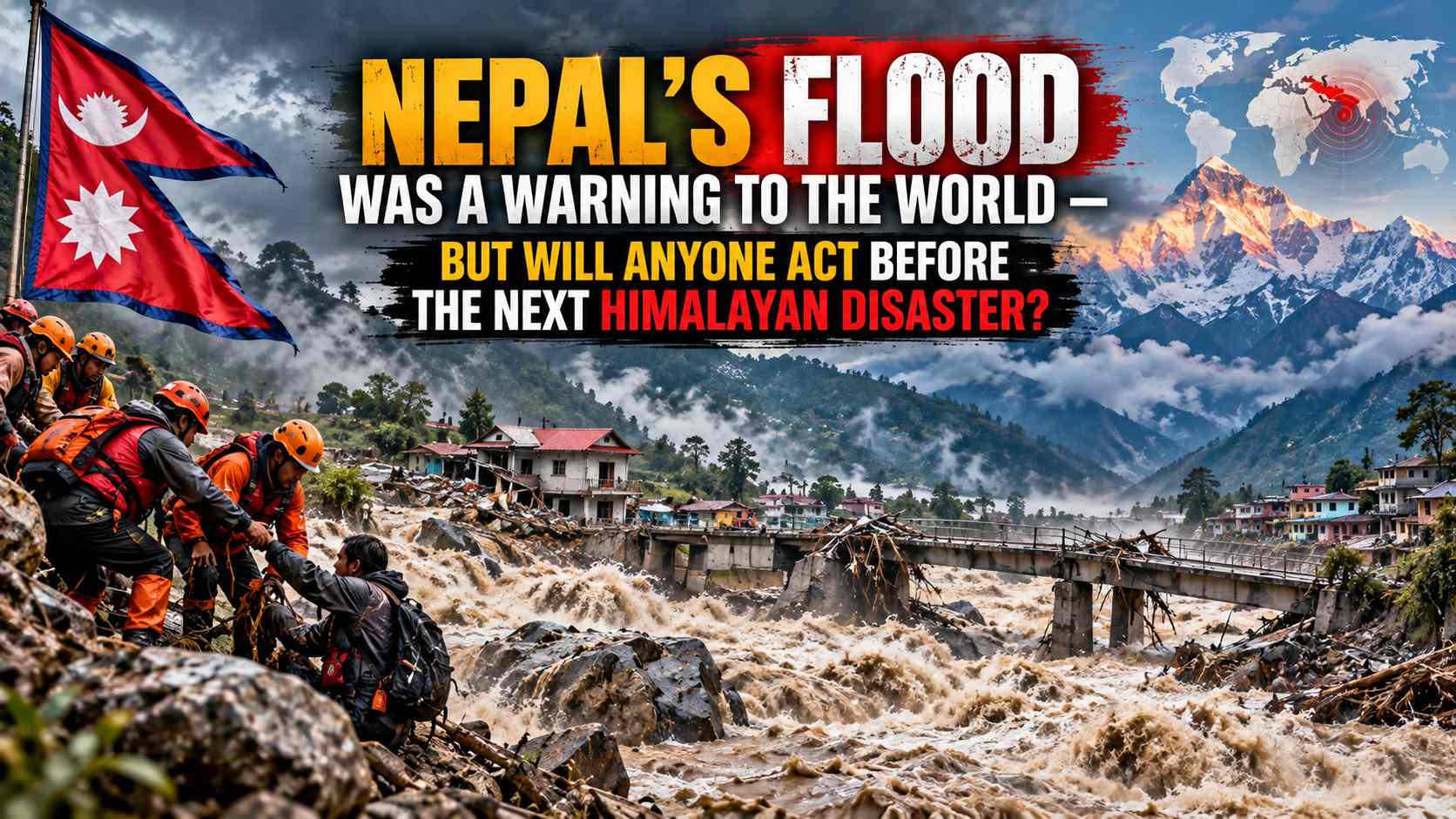
When Nepal’s Prime Minister Balendra Shah stood before world leaders at the United Nations, he did not describe his country’s devastating August flood simply as another natural disaster.
He called it a warning.
The message was aimed far beyond Nepal’s borders. A catastrophic collapse in the Himalayas triggered a torrent of water, ice, rock and debris that swept through communities, destroyed infrastructure and left a death toll of at least 1,450. More than 6,000 people remain missing, according to the latest reporting.
For Shah, the tragedy is also an argument about climate responsibility.
Nepal contributes only a tiny share of global greenhouse-gas emissions, yet it is facing some of the consequences of a warming planet in one of the world’s most fragile environments.
His question to the international community was therefore straightforward: if this is what a rapidly changing Himalaya can do today, what happens when similar risks become more frequent and more difficult to predict?
A Disaster That Started High in the Mountains
The catastrophe began on August 26 near the Nepal-China border when a large section of rock and glacier collapsed.
The resulting landslide and debris flood moved downstream through Himalayan valleys, causing widespread destruction along the Trishuli River corridor.
The damage was enormous.
Roads disappeared. Bridges were swept away. Homes and schools were destroyed. Hydropower facilities were hit, and workers became trapped inside underground tunnels.
Weeks later, rescue and recovery teams were still searching for missing people. Reuters reported that more than 6,000 remained unaccounted for, while many may never be recovered.
This is what makes the disaster particularly difficult to treat as an ordinary flood.
It was a cascading mountain event, where several hazards came together with extraordinary speed.
Climate Change Did Not Act Alone
There is an important distinction in understanding what happened.
Scientists have not concluded that climate change alone caused the August disaster.
A World Weather Attribution analysis found that human-caused warming likely contributed to the conditions that made the mountain slope less stable. Rising temperatures have caused glaciers to thin and mountain permafrost to thaw, weakening natural structures that can help hold steep rock faces together.
The researchers also pointed to geological factors, including the possibility that the 2015 Nepal earthquake weakened the rock over many years.
So the more accurate picture is not “climate change caused the flood.”
It is more complicated — and arguably more worrying.
A changing climate may be altering the conditions under which mountains remain stable, adding another layer of danger to a region already exposed to earthquakes, landslides and extreme weather.
The Himalayas Are Becoming a Different Risk Environment
For decades, climate discussions have focused heavily on rising temperatures, stronger storms, droughts and sea-level rise.
The Nepal disaster illustrates another dimension.
Climate change can also affect the physical stability of mountains.
As temperatures rise, glaciers retreat. Frozen ground can thaw. Meltwater can increase. Rock that was previously supported or locked together by ice can become more exposed and unstable.
That does not mean every glacier will collapse.
But it does mean that the background conditions are changing.
The World Weather Attribution study warned that the August event was beyond the design and predictive limits of existing risk-reduction systems. Conventional flood-warning systems can help when rainfall and river levels provide enough warning, but a rapidly developing rock-and-ice avalanche presents a very different challenge.
In other words, the problem is not simply that floods may become bigger.
Some disasters may become harder to see coming.
Nepal Wants More Than Emergency Aid
Shah’s message at the UN was therefore about more than rebuilding roads and replacing bridges.
Nepal estimates that recovery and reconstruction could require resources equivalent to roughly 10% of its gross domestic product.
The prime minister has called for grant-based international assistance rather than relying heavily on loans.
His argument is straightforward: a poor, climate-vulnerable country should not have to accumulate large amounts of new debt every time a climate-related catastrophe destroys infrastructure and livelihoods.
This turns the Nepal disaster into a broader debate over climate finance.
Should vulnerable countries receive more assistance before disasters happen, so they can strengthen infrastructure and warning systems?
Or should the international system continue to provide substantial assistance mainly after catastrophe has already occurred?
Nepal is clearly arguing for the first approach.
The World Has Already Started Responding
Some international support is arriving.
The World Bank has made up to $170 million in emergency financing available for Nepal’s response and recovery.
The United States has also announced additional assistance.
But Kathmandu argues that emergency funding alone is not enough.
The bigger requirement is long-term resilience: stronger infrastructure, better monitoring, improved forecasting and systems capable of detecting rapidly developing mountain hazards.
That is a much more expensive proposition.
And it raises a difficult question: how much should the world spend preparing for a disaster that may or may not happen, compared with the enormous cost of rebuilding after it does?
Nepal Is Calling for a Himalayan Warning Network
One of Shah’s most significant proposals involves cooperation between Nepal, India and China.
The three countries share the Himalayan region but do not share a single system for dealing with every cross-border climate and mountain hazard.
Shah has called for an urgent Himalayan mechanism that could share satellite information, monitor glacial lakes, strengthen early-warning systems and coordinate disaster responses across national borders.
That proposal reflects a basic reality of geography.
A mountain does not stop being dangerous because a national border runs through it.
A landslide or glacial flood can begin in one country and affect communities downstream in another.
Rivers also cross borders.
So can climate risks.
The September 26 disaster demonstrated how difficult it can be to manage those hazards using purely national systems.
Early Warning Has Limits
Early-warning systems are often presented as one of the most important tools for protecting vulnerable communities.
And they are.
But the Nepal disaster demonstrates that warnings are only useful when authorities can identify the threat early enough.
If a conventional flood develops over several hours, communities may have time to evacuate.
A sudden mountain collapse can operate on an entirely different timescale.
The World Weather Attribution analysis concluded that existing systems could not have provided sufficient warning to prevent the scale of destruction in the worst-affected areas.
That does not mean warning systems are useless.
It means they must evolve.
Satellite monitoring, glacier observation, ground sensors, geological mapping and cross-border data sharing may become increasingly important as Himalayan risks change.
The Economic Cost Goes Far Beyond the Flood Zone
The destruction is also an economic problem for a country that depends heavily on roads, hydropower, tourism and mountain communities.
When bridges disappear, transportation becomes more difficult.
When hydropower facilities are damaged, electricity generation and investment are affected.
When roads and communication networks are cut, emergency response becomes slower and local economies can be isolated.
And when thousands of people remain missing, the human and economic consequences continue long after the water disappears.
Reuters reported that some hydropower facilities along the Trishuli corridor were badly affected, with rescue teams searching underground tunnels where workers may have been trapped.
The disaster therefore exposed vulnerabilities in infrastructure that may have appeared economically valuable during normal conditions but became extremely dangerous when a massive debris flow arrived.
Nepal’s Message Is Also About Climate Justice
There is another layer to Shah’s argument.
Nepal is emphasizing the imbalance between contribution and consequences.
The country has contributed very little to global greenhouse-gas emissions compared with major industrial economies, yet its geography makes it particularly exposed to warming-related changes in glaciers, snow and mountain ecosystems.
That is why the Nepalese government is linking reconstruction assistance with the wider debate over climate responsibility.
The argument is not simply that Nepal needs money.
It is that international climate policy should account for countries that face severe consequences despite having contributed relatively little to the problem.
That debate is likely to become more important as climate-related disasters increasingly test developing countries’ ability to recover.
The Real Warning May Be About What Comes Next
It is tempting to view the Nepal flood as an extraordinary event that can be treated as an isolated tragedy.
Scientists are urging a more cautious interpretation.
The exact combination of geological and climatic conditions that produced this disaster may never repeat in exactly the same way.
But the underlying trends are not disappearing.
Glaciers are retreating.
Permafrost is thawing.
Temperatures are rising.
Mountain communities continue to expand and develop infrastructure in narrow valleys.
Those factors can interact in unpredictable ways.
The result is a new kind of risk: disasters created not by one hazard, but by several hazards cascading into one another.
India and China Cannot Ignore the Warning
Nepal’s call for greater cooperation with India and China is particularly significant because the Himalayas are a shared environmental system.
Information about glaciers, rainfall, river flows, landslides and changing mountain conditions can have value far beyond one country’s borders.
Better regional cooperation could mean faster warnings, stronger evacuation planning and more effective rescue operations.
But it also requires governments to share data and cooperate despite their broader political differences.
That may be difficult.
Yet the mountains create a practical reason to cooperate that politics cannot easily erase.
A collapsing glacier does not recognize a border.
Neither does the river that follows.
The Question Now Is Whether the Warning Will Be Heard
Balendra Shah used the UN to turn Nepal’s tragedy into a global appeal.
His central argument is that the international community cannot wait for vulnerable countries to suffer catastrophic losses before providing meaningful support.
The August disaster killed at least 1,450 people, destroyed critical infrastructure and left thousands missing. Scientists say climate change likely intensified some of the long-term conditions that contributed to the mountain’s instability, even though warming was not the sole cause.
That distinction matters because it points toward a more useful response.
The lesson is not that every future Himalayan disaster can be blamed on climate change.
The lesson is that climate change is modifying an already dangerous environment.
And that means preparation has to change too.
Nepal’s flood was a warning.
The real test now is whether the world treats it as a tragic headline from one month — or as an early signal of a much larger challenge facing the Himalayas.